Wednesday, March 11, 2015

Waste Plastic in the Oceans - A Comparison of the Inputs from Two Countries

The journal Science published last month a new report ($) that attempted to quantitate the various global inputs that going into making up ocean plastic, perhaps better known as the "Great Garbage Patches". The major media outlets focussed on the fact that the amount of plastic in the patches is quite a bit less than expected. But the American media overlooked (by and large) this chart:
Ocean plastic waste by country
Source

This chart alone goes a long ways towards suggesting that the US isn't contributing as much garbage to the ocean as other countries. (Are you surprised as I am to see that impoverished North Korea contributes more? How does that happen?) As I read this chart, China contributes about 4.8 billion pounds per year, while the US contributes about 0.2 billion pounds, about 24 times less.

Keep in mind that these are absolute numbers for entire countries. Let's play around with them some.

You could arguably rerun the numbers on a per capita basis. China's population is about 1.4 billion while the US's is about 320 million, a factor of 4.4. This means that the per capita contribution of China to ocean plastic is about 5.5 times worse than the US's (24/4.4). For every one bag that someone in the US lets loose into the ocean, someone in China is letting loose 5.5 of them.

Another way to look at the numbers would be to scale them for the total plastic consumption of each country.
Plastic consumption by country
Source: http://www.pardos-marketing.com/hot03.htm
I had a surprisingly hard time finding total plastic consumption by country in a tabular form, but the chart on the right does shows plastic consumption per capita for various countries and regions, so we can work with that. The US consumes about 130 kg per capita (the scale is logarithmic) or about 92 billion pounds for the entire country while the per capita consumption in China is just under 8 kg, which works out to about 25 billion pounds, 3.7 time less.

So of the 92 billion pounds the US consumes, only 0.2 billion pounds make it into the ocean, which is 0.22%. For China, of the 25 billion pounds consumed, 4.8 billion make it into the ocean, which is 19.2%, 87 times as much. Which means the US is 87 times more efficient at preventing ocean plastic from occurring.

These calculation are not ideal. There are a number of geographical inputs that I wish I had access to. Such as numbers for the population that lives near the coast (and therefore more likely to have their loose waste end up in the ocean). And the size of the coastline would be another factor. (I doubt that a doubly landlocked country like Uzbekistan contributes much to ocean plastic). And then there is the whole breakdown of durable versus consumable plastics as well.

The point of all this is not to point the finger at China or anywhere else or to say that the US can sit back and feel pretty good about itself. 200 million pounds a year is 200 million pounds too much. Plastic waste has no business being in the ocean. But it does raise the question of how important it is to identify the sources of the US's ocean plastic contribution and once that is known, finding effectively solutions to it. Plastic bag bans make great political hay, but are the really effective? Particularly ones that are in cities remote from the ocean such as Iowa City.


Previous Years

March 11, 2014 - Be Gone, Heater Bands!

March 11, 2013 - What's Wrong With This Picture?

March 11, 2010 - Qualitative Science

March 11, 2009 - The "Most Admired" Chemical Company

March 11, 2009 - Dow and Rohm & Haas - The Last Word?

March 11, 2009 - Yet another rant

Tuesday, March 10, 2015

K-Cups

I have to honestly admit that I've never really thought about K-Cups much. Don't be surprised, as after all, I don't drink coffee. (I prefer my caffeine like my salads - cold and green - i.e, Mountain Dew.) But a recent interview and article in The Atlantic with John Sylvan, the inventor of the K-Cup has me taking a closer look.

Sylvan is denouncing his invention and admits to not even owning a Keurig machine. Besides the expense compared to a normal drip coffee-maker, he is also concerned about the K-Cup containers and their lack of recyclability.
" 'No matter what they say about recycling, those things will never be recyclable,' Sylvan said. 'The plastic is a specialized plastic made of four different layers.' "
I admit again, that I never it gave it much thought, but the package is pretty complicated. The cups have to protect the ground coffee from oxygen. That's easy for the top of the cup which is a piece of foil, but the plastic cup itself requires an oxygen-barrier plastic, such as ethylene-vinyl alcohol (EVOH) or polyvinylidene chloride (PVDC, aka Saran [*]). And that's where the problems start. Barrier plastics are great at being barriers, but seldom perform well on their own and so they are usually incorporated into multilayer films or sheets such as in this case. And hence the concerns with recyclability and why they are marked as plastic #7 (Other).

"....a specialized plastic made of four different layers". That's odd, because it isn't odd. To be clearer, that's odd because it isn't an odd number of layers. Barrier plastics are usually more expensive than the base plastic, so thin layers are typically used. This can lead to problems with holes in the thin layers, so to address that, typically 2 or more layers of the barrier plastics are used with the thought being that the odds of two holes in the barrier layer being in the same are other is remote. The construction would then be base/barrier/base/barrier/base - which is an odd number of layers - 5. It can get even more complicated when the base and barrier don't stick to each other. Then a tie-layer can be coextruded, which further increases the number of layers. But even if the barrier plastic is still only used once as in a base/barrier/base construction, you still have an odd number of layers - 3. I'm not sure how you could effectively have a 4-layer construction.

I'm not sure what plastics are used as the base in the cup and in the filter (the patent is expectedly plenty vague.

I would encourage you to read the entire article as the bottom-most section gives an interesting perspective on how the Keurig machines and K-Cups might not be as bad as we might think. They can unexpectedly reduce waste in other ways that we accept without question. The author describes the issues very well, so it's pointless for me to try and repeat them. But you will see that the reaction to K-Cups is very much like the reaction to disposable water bottles. By focussing on just the delivery device right before, during and after the consumer uses it, you miss out on the bigger picture. An optimized solution is never found by optimizing just one part of the problem or by optimizing each part separately, but instead by looking for a global optimum. That such global optimums may appear to be non-optimized in a local area can be confusing at times.


[*] Saran was the tradename that Dow first used when introducing this material as a household plastic foodwrap. The product line has since been sold to S.C. Johnson who kept the tradename, but changed the plastic to a chlorine-free alternative.


Previous Years

March 10, 2010 - The Great Pacific Garbage Patch

Friday, March 6, 2015

Commenting

If anyone reading this blog wants to comment on any post at any time, feel free. You can do it anonymously, no registration is required, and the CAPTCHA option is simply to click on a box. I can't make it any easier than that.

So go for it. Opine away. I only ask that you be civil. If you wouldn't be comfortable saying it to your mother, then it probably shouldn't be written down either.

Thursday, March 5, 2015

The "Reader's Digest" version of my recent posts on estrogenic activity arising from BPA-free plastics

The last 3 posts (1, 2 and 3) have gone into quite a bit of detail and at length of the research results of George Bittner and his claims that many BPA-free plastics show estrogenic activity (EA). Here is a short summary of the main points. There are also hundreds of other detailed criticisms of the research, (only some of which I discussed in the previous posts) that further raise doubts about the validity of the conclusions reached by the researchers.

  • Almost the entirety of the claims are based on samples that have been rapidly "stressed" in someway to "simulate" stresses that would naturally occur to the plastic over longer periods of time during normal use.
  • Unfortunately, there is no effort made to understand if the aging that occurred in the rapidly-stressed plastics resembled in anyway the aging that would occur in naturally-stressed plastics.
  • Verifying that there is no aging difference between the rapidly-stressed and the naturally-stressed samples is critical since at no point are the specific EA chemicals identified.
  • This means we do not know if the EA chemicals are artificially-introduced artefacts from the extreme stress conditions or not.
  • This means that we cannot accurately make statements that BPA-free plastics, when used in a normal manner, will also show EA.

That's enough talk about estrogenic activity in plastics for a while.

Previous Years

March 5, 2014 - Mother Jones Tries to Raise the Dead with a "New" Expose of an Old Issue

March 5, 2012 - Here come the Patent Trolls

March 5, 2010 - Reductio ad absurdum

March 5, 2009 - Some hints on the Rheology of Ketchup

March 5, 2007 - Information just wants to be free

Wednesday, March 4, 2015

Is Tritan Plastic Free of Estrogenic Activity (Part 3)

[Note: This is the third part of a 3-part series taking a critical look at the work of University of Texas - Austin neuroscience Professor George Bittner regarding estrogenic activity in plastics. Here is Part 1, which gives general criticisms of his work in this area, and here is Part 2 which looks critically at the results of a 2014 publication.]

The second of two recent papers by George Bittner et al. looking at the estrogenic activity (EA) in BPA-free plastics was also published in the journal Environmental Health. It is also open access, so again, feel free to pull a copy and read along with me.

This paper is very similar to the paper discussed in part 2 and so I won't bother repeating my earlier criticisms as they are still valid. However, they researchers have finally begun to address the issue of a naturally-aged control. But they still didn't manage to not screw it up.
"Natural sunlight stresses: plaques were placed individually between a quartz glass plate on top and aluminum foil on a porcelain plate below. The two plates were clamped together using binder clips. To control for heat versus sunlight effects, some of these plaques were wrapped in thick aluminum foil. These plaques were placed on the roof of CCi�s facility for 1�14 days in summer." (Note: CCi = Certichem Inc, the company for which the researchers work)
Natural sunlight - good. Quartz glass - bad (it will trap heat). Aluminum foil beneath the samples - bad (it will reflect back the UV). Wrapping everything in thick aluminum foil - ??? And how is this suppose to work? Better yet, did it work? And your proof of this is ________? Or does your new "control" need another control?

And the data is still being cherry picked:
"The greatest %RME2 response of 4�8 dilutions of a test chemical or extract run in triplicate was considered detectable if it produced an effect whose average %RME2 was greater than 15% RME2..."
That's right. Run the test 3 times and if just one of the samples is positive, the whole set of experiments is positive.

Unlike the previous work, ethanol is now the preferred extraction solvent, to which again, I ask "why"? Tritan bottle are generally used as reusable water bottles, not reusable drink bottles. And even if alcoholic drinks are place in the bottles, the alcohol itself has plenty of estrogenic activity, possibly more than enough to make moot concerns of chemicals with EA in the plastic.

For the life of me, I cannot figure out why the researchers haven't run the simplest and most appropriate test of all. Take a bottle of Tritan or whatever other glassy plastic you are trying to skewer this year, wash it out with soap and water (like a normal consumer would before their initial use), fill it up with water and let it sit for 2 weeks. Let it sit in the fridge or let it sit in a car or let it sit up on the roof of the CCi building and then look for EA in the water. Just do something with it that a normal person would do instead of acting like that's not good enough. The researchers have had 3 whole years to do this, but instead have entirely focussed on horribly-erroneous stress-tests that render their entire results worthless.

Is that really asking too much? Because if you did that, if you actually used the bottle like a normal person would and if you saw chemicals with EA being transferred to the water, then no one would be able to seriously question the results, would they?


Previous Years

March 4, 2013 - Two Oobleck Videos - 1 Good, 1 Bad

March 4, 2011 - More Thoughts on "Materials Science"

March 4, 2011 - Good News on the BPA Front

March 4, 2010 - Chemical (er... Biological) Switching

Tuesday, March 3, 2015

Is Tritan Plastic Free of Estrogenic Activity? (Part 2)

[Note: This is the second part of a 3-part series taking a critical look at the work of University of Texas - Austin neuroscience Professor George Bittner regarding estrogenic activity in plastics. Here is Part 1, which gives general criticisms of his work in this area and here is Part 3 which like Part 2, looks critically at recent publications of Bittner's.]

The first of two recent papers by George Bittner et al. looking at the estrogenic activity (EA) in BPA-free plastics was published in the journal Environmental Health. It is open access, so feel free to pull a copy and read along with me. (As an aside, all of Bittner's articles are published in non-plastics oriented journals, which is probably why he is able to get away with making so many mistakes in creating stress-tests for his samples. The reviewers are likely equally unfamiliar with polymeric materials and their proper testing.)

Overall, I found this recent work to be much more contrite than previous work, lacking the cocksureness of his previous writings. The papers are longer, in part due to taking more time to explain, clarify and rationalize the test methods employed. Broad, sweeping conclusions are not as prevalent. I can't but feel that this is in part due to the lawsuit over the previous work and statements, and maybe even due to my earlier criticisms.

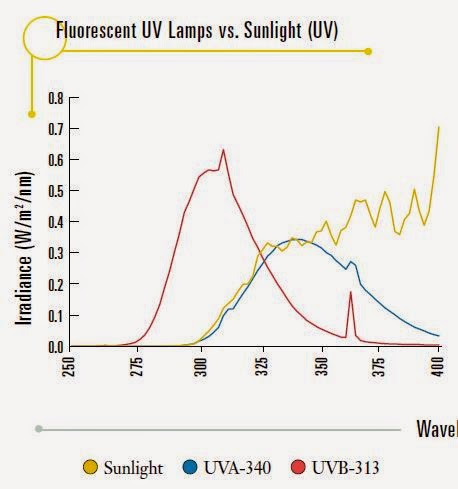
For instance, he has introduced an additional UV testing protocol using UVA bulbs although the germicidal lamps are still being used.
UVA bulbs are better at simulating sunlight than germicidal lamps, but they still are problematic as the graph on the right shows. There is a good match at the lower wavelengths, but the problem is that not all plastics are degraded by shorter wavelengths. A classic paper by Andrady introduced the activation spectra for polymers, a graph which shows that the degradation rate versus the wavelength. Most plastics have a peak in such a plot, with some peaking at higher wavelengths than others. Lacking the activation spectra for a polymer, it is therefore critical to attempt to match the UV spectra of sunlight across the entire UV spectra, not just across a portion that is convenient to test. (Fluorescent bulbs are cheaper to buy and maintain than xenon arc sources, even though the latter can provide a much better spectral match.)

In the past, EA was found by using just the MCF-7 assay, a test that Eastman's experts were quite critical of. This paper also uses a BG1-Luc assay test from UC Davis. Sorry, I don't have enough of a biochem/cell biology background to criticize the test effectively comment on the tests and their validity. But a couple of items did catch my eye. The samples were sometimes extracted with 100% ethanol or various water/ethanol solutions. Why? Also, a variety of blanks were run as controls. But this then lead to selection bias in the results, since when any sham control showed an EA greater than 15% of the response produced by 17β-estradiol (RME-2), the entire experiment was tossed. Why?

The researchers did not run every sample through every stress option and every extraction option, but did a scattering of text configurations. All of which makes it difficult to make broad statements, but nonetheless, I think Figure 3 is telling:
This shows the EA for a variety of samples. 15% RME2 is used as the cutoff for "estrogenic activity". Across the bottom, UN is for unstressed samples, AU is for autoclaved samples, MI is for microwaved samples and UVA and UVC are for the samples exposed to the UVA- and germicidal-lamps respectively. To me, the conclusion is pretty clear. Give so much variation in EA across so many different samples of different colors and processed by some many different manufacturers, it's evident that the base Tritan resin itself does not show EA as seen in Figures 3A and 3B. It's additives, colorants, and processing conditions that lead to a material that can show EA.

For reasons that are not completely clear, the researchers decided to take this matter into their own hands and "roll their own" plastics with additives. They somehow (think) they properly added BHT or BHA to polypropylene. I can't imagine that they did this properly (no details were given - where were the reviewers on this?) and I take issue with the whole approach as well. First, BHT and BHA are seldom used as antioxidants in polymers. Not only are they too volatile, evaporating out of the molten plastic, but they also are rather mobile and will diffuse rather well, leaving the plastic devoid of protection. Instead, BHT derivatives are used. Multiple equivalents of BHT (or BHA) are covalently bonded to a central multifunctional molecule, such a pentaerythritol. The BHT segment is still functional as an antioxidant, but the new molecule is far less volatile and diffusive. So looking at the EA of BHT and BHA (Figures 6A and 6B) is a non-issue for plastics. But secondly, attempting to add and disperse the additives in polypropylene is not something that can be done without the proper equipment. Molten polypropylene is a thick viscous mess and attempting to disperse less than 1 wt% of an additive in a beaker of molten polypropylene with a glass rod is not possible. You need some proper compounding equipment, usually something with intermeshing twin blades in a steel vessel, all of which is heated up.

But then I look at Figure 6C and I want to cry. Some unidentified antioxidants (therefore not something that can be independently verified) were added to polypropylene, and then the polypropylene was kept at 200 oC for 100 hours!!! What was left of the sample if anything beyond a burnt crisp of something that you to be plastic? And somehow the researchers believe that the results are representative of something? How can anyone believe that? 200 oC for 100 hours. Imagine if you had stuck say, a leg of lamb (or a tofu turkey if you are vegetarian) in your oven at home at set it to 200 oC (400 oF) for 100 hours? Besides having multiple visits from the fire department and divorce papers from your spouse ("But Honey! I'm doing this for SCIENCE"), what would be left? Polypropylene is not that different. Why, oh why, oh why does anyone think that this test protocol is of any use at all? And then doesn't that cast an immense question mark across the rest of the test protocols as well?

All in all, this paper, like the previous paper, is just a mess wherein plastic samples have been subjected to extreme questions without merit and then tested for EA. All the previous criticisms I have with this researcher's results still stand. Even when appearing to be responsive and adjusting some test protocols, additional tests, including one which is by far the most abusive test I can imagine have been added. And yet, through it all, there is sufficient data to answer the question I posed in the headline. Is Tritan plastic free of Estrogenic Activity?

Based on the data in this paper, the answer is yes.


Previous Years

March 3, 2011 - On the term "Materials Science"

March 3, 2011 - Who Knew?

Monday, March 2, 2015

Is Tritan Plastic Free of Estrogenic Activity? (Part 1)

[Note: This is the first part of a 3-part series taking a critical look at the work of University of Texas - Austin neuroscience Professor George Bittner regarding estrogenic activity in plastics. Part 1 here gives general criticisms of his work in this area, while Part 2 and Part 3 which looks critically at the results of a pair of 2014 publications.]

It's been a while since I've discussed the work of neuroscientist Prof. George Bittner who claims to have found estrogenic activity (EA) in a wide range of plastic materials, not just polycarbonates that are known to show EA due to the residual bisphenol A (BPA) that resides within them, but polyethylene, polypropylene and more. Pretty much all plastics were implicated, which was quite shocking. This paper came out back in 2011 and he worked up quite a publicity train of hype trumpeting the results in interviews with major news outlets such as the New York Times. Not only was this PR tour driven by his "results", but also by the fact that he owns two companies, Certichem and Plastipure, which are involved in running these types of tests and then supplying plastics that pass the tests, respectively. So you could say there was a potential conflict of interest.

I (and other researchers) had no problem in quickly finding major flaws in the work. His work involved "stressing" the samples, and it was these stressed samples that showed high levels of EA. But there were significant problems with his stressing protocols, namely that he had no controls at all. While Bittner would argue that an unstressed sample would be a control, it isn't. Whenever any is running accelerated "stressing" of plastics (more commonly known as accelerated aging), you need to have control samples that are undergoing natural aging. Without those naturally aged controls, you have no idea if the stressing is in fact aging the samples properly or if it is producing unnatural results.

The classic example are chicken eggs. Heating up a dozen of them in boiling water for 10 minutes is not going to give you a batch of new chicks. That's because excessive heat accelerated undesired chemical reactions, reactions that don't occur in natural aging. Heating and cooling the eggs only within a very-narrow temperature-window will speed-up/slow-down the hatching. Anything else will produce unnatural results.

Or think of it this way, in terms of an imaginary movie script. The bad guys want to know where the good guy keeps some unknown valuable item that they are looking to steal. The natural-aging analogy would be for the bad guys to tail closely the good guy. The accelerated-aging analogy would be for the bad guys to be driving faster ahead of the good guy, occasionally looking in the rear view mirror to see that he's still there. If they correctly predict the good guy's route, they will get to the valuable item first. But if they look back and see that he's turned onto a different route, then the bad guys need to turn around, go back to that turning point and continue. It would be crazy for the bad guys to drive quickly without ever looking back at the naturally-aged control (i.e., the good guy). Such a scene would mean only that they will get somewhere fast, but it may or may not be the right spot at all. Yet that was what Bittner was doing. Going somewhere fast, but with no idea or proof that the final result was correct at all.

And this is not just me saying this. Take a look at these three pictures.
Outdoor Weathering Facility
Miami FL, USA


Phoenix AZ, USA
Magdeburg, Germany
These are all large outdoor weathering facilities and there are dozens of others from around the world that are not shown. If accelerated aging was merely a matter of counting photons, these facilities would not be needed at all.

For Bittner's research, it was even more important than usual to have a proper control as his test methods never identified what specific chemicals were showing the EA. And so it was impossible to know whether it was one or more chemicals that were created during the stress that didn't even exist in the unstressed plastic. Or if the the chemicals would ever develop under natural aging conditions.

Beyond lacking in a naturally aged control, Bittner's stressing protocols were extreme and therefore all the more likely to produce erroneous results. He simulated natural UV aging by exposing the plastic to 254 nm UV light, light that is not naturally occurring on earth, light that is known to be highly energetic and destructive to organic materials. Hence it's use as a germicidal lamp. Photons with a 254 nm wavelength chop up chemicals like a wood chipper chops wood, and all little bits are new chemicals that weren't there before. (Hence my very strong concern for a naturally-aged control.) Similarly, Bittner simulated a dishwasher with an autoclave. (Huh? Don't they have dishwashers in Austin, Texas?) An autoclave produces much higher heat than any dishwasher and it also doesn't "wash" anything. A dishwasher loaded with soap would wash away chemicals that diffuse to the surface which would decrease the chance of producing positive EA results. Similarly, Bittner ran a bunch of plastic samples repeatedly through a microwave. While this appears to be a realistic procedure, very few people run the same container 10 or more times through the microwave without washing it in between uses. And such a washing step would reduce any EA chemicals at the surface. You can now see that these "stress" tests were really just doing a bunch of extreme things to plastic samples that are not correlated to realistic conditions at all. I stated all of this in earlier posts back in 2001. (And it seemed to have had an effect as you will see in Part 2 of this series of posts.)

The accusations made some people upset, including Eastman Chemical. Eastman makes the Tritan family of plastics and has been pushing them heavily as a BPA-free alternative to polycarbonate. Bittner accused Tritan of showing EA, Eastman disagreed and the gloves came off, only being put back on after a jury in Texas agreed that Bittner's claims were invalid. Bittner appealed and lost there too.

Bittner has not given up the fight however. He published two new articles on the same subject matter late last year (which I will criticize wholeheartedly in parts 2 and 3), and is still making interviews, such as a recent one to National Public Radio.
"...Bittner's companies have changed their tactics a bit, says Mike Usey, the CEO of PlastiPure. 'We don't talk about Tritan, or Eastman, in a commercial context concerning the testing results that we have,' he says. 'But that doesn't limit our discussing our research in a scientific context.' That means Bittner and his companies are getting their message out by publishing scientific papers about estrogenic plastics that specifically mention Tritan and products made with it."
While they have changed their tactics on the PR trail a bit and are very careful in their new papers how they mention Tritan, they haven't changed their research tactics. They are still lacking in proper controls, and worse yet, they ignorantly continue to find new ways to abuse plastics without merit or reason, thinking that they are proceeding just fine. Bittner and company may well be fine neuroscientists, but they know next to nothing about polymer chemistry and processing plastics.

A leopard cannot change its spots.


Previous Years

March 2, 2012 - Cancelling a Stink with another Stink?

March 2, 2011 - Nonlinearity in Rheology - Be Afraid, Be Very Afraid

March 2, 2010 - Living without Plastics?

March 2, 2009 - Polymers and their Solubility

March 2, 2009 - Mylar - What it Isn't