Showing posts with label health. Show all posts

Thursday, August 6, 2015

PVC-induced Acroosteolysis?

I look forward to my inbox on Thursdays because in it will be the links to The New England Journal of Medicine's "Images in Clinical Medicine". These are open access images that doctors from around the world have submitted that show something that is visually unusual in a patient that they examined and possibly treated. The images can be photographs, MRI's, x-rays, etc. and have a brief discussion about the condition, treatment and outcome.

This week, PVC was considered (but ruled out) as inducing the fingertip bones in this man's hands to be absorbed by his body:
Acroosteolysis
Source

The condition is called acroosteolysis [1]. PVC gets blamed for lots of things, but I thought it was odd that it, the polymer itself, would get the blame. A more likely cause would be the monomer (vinyl chloride, VCM), the catalyst or any of the various additives that are added to PVC (and there are A LOT of additives added to PVC). I dug a little further and that is where it gets interesting. I found a link to an Italian-language report on acroosteolysis in people that used to manually clean the tanks used to polymerize PVC.

"The disease was observed for the first time in mid-1963 in Belgium (Jemeppe) in a chemical plant operated by Solvay, and affected two workers whose job was the manual cleaning of vessels used for the polymerization of vinyl chloride; similar cases occurred in almost all PVC production plants all over the world, but not in the plants where the main activity was the production of vinyl chloride monomer (VCM). Little more than one hundred cases are described in the scientific literature, and this number increases by a few dozen if we consider known but unpublished cases. These figures confirm the rarity of the disease, which peaked at the end of the 1960's and disappeared during the 1970's, probably due to the complete elimination of manual reactor cleaning. Observation of the disease lasted no more than fifteen years and the disease was not replicated in experimental conditions on animals.

The disease was clinically characterized, had a short latency (from several months to several years), was rare and unequivocally linked to the manual cleaning of PVC polymerization tanks. However many questions still remain open: the period when the disease first appeared (many years after the start of PVC production in the world), the etiology of the disease (the most accredited hypothesis considers three concomitant factors: a chemical factor--one of the many substances used during polymerization, and particularly vinyl chloride monomer, a physical factor--microtraumas of the fingers during manual cleaning, individual susceptibility), the pathogenetic mechanism (in particular: the role of skin, respiratory, or digestive system, as entrance door), a method (or test) to screen subjects potentially predisposed to the disease. In our view acroosteolysis of manual tank cleaners in PVC production is an occupational disease which is distinct from "vinyl chloride disease" as identified by Viola (1974)."
[2]

That's a puzzler alright. PVC was first produced commercially back in the 1920's and yet this condition didn't appear until the 60's. So what changed? And what is there that the workers would have been exposed to that would have led to acroosteolysis, such a very rare and unusual condition? Despite what the doctors stated, I doubt that it is the PVC itself as workers that process PVC in all it forms don't seem to suffer this way. Most of the additives to the PVC would be added in a post-polymerization operation (having all those compounds around during the polymerization would be a nightmare). So what was the cause?

Given that the condition amongst workers has extinguished itself, I doubt that we will ever know what the cause was.


[1] If I am parsing this word correctly, acro- refers to the extremity, osteo- refers to bone and -lysis refers to the breaking down. Acroosteolysis - a good name.

[2] That second to last sentence needs some help, but it's beyond me as to how to rewrite it correctly, so I left it as it was originally written.

Previous Years

August 6, 2014 - So you want to develop sustainable polymers, do you?

August 6, 2013 - Where There's Smoke, There's Bad Smells

August 6, 2012 - The Secrets of Oobleck Revealed - Partially

August 6, 2010 - Backlash on BPA - Infertility Report

Thursday, May 7, 2015

Fast Times at Aspen Research

Looking back on all the job changes that I've made over the decades, I really don't regret any of them (regardless of whether I left the job or the job left me!). But a recent local news report made me "light up" when they mentioned a former employer - Aspen Research.

Before we get to them, you need to know that last year, Minnesota approved the use of medical marijuana. You can't grow you own, but have to get the stuff from certified dispensaries which are supplied by certified growers. And as a compromise needed to get the bill approved by the governor, the THC and CBD can only be in pill or oil form - no smoking allowed. And that means that someone needs to test the pills and oil for the content of the active pharmaceutical ingredient. And that's how Aspen Research entered the picture. They were one of two labs selected by the state to perform that analysis.

Oil? As in a liquid? As in there is some rheology that should be studied? Oooh! Let me help! It's probably going to take a lot of material to get a good protocol set and there will be lots of waste and nothing left over to return to my supervisor...

But seriously, I am happy for Aspen that they got this contract. They are ISO 17025 certified, and at least one of the people on staff has prior experience with testing wacky tobaccy, so it was a good choice for the state.

And no, this really doesn't change my thoughts about going back there. The reasons I left that job are still just as valid as they were before. Besides, I've never yet partaken of the stuff and I'm not about to start.


Previous Years

May 7, 2014 - Innovations in Polyurethanes Blog

May 7, 2013 - "Downcycling" of Plastics - It's Time to End the Destructive Namecalling

May 7, 2010 - 99 Plastic Bands on the Wall...

May 7, 2010 - Seeing the Spin

May 7, 2009 - I guess this is the week for "Peer Review"


Tuesday, April 28, 2015

The Antibacterial Properties of Silver can be "Long Lived"

While polymeric materials are seldom consumed by bacteria, the surfaces can still provide a location for bacteria to live on, especially if the surface is contaminated with substances that can sustain bacterial life. One common way to prevent this is to add various toxic metals to the polymers such as silver or copper. The use of these metals to control bacteria has been known for centuries, but a new research report (OPEN ACCESS!) puts a new twist on just how effective silver can be: the bacteria that have been killed by silver nitrate are themselves capable of killing additional bacteria. Apparently the silver in the dead bacteria serves as a reservoir to kill additional bacteria. The researchers believe that copper would be able to act in a similar fashion.

The researchers provide an "interesting" take on what they observed: Dead animals are able to kill living animals of their same species. There is one and only one word for this type of behavior: ZOMBIES! And that's exactly the word that the researchers used. It's a little bit of a stretch as the dead bacteria are not actively pursuing the live ones, but it certainly draws your attention in.


Previous Years

April 28, 2010 - Overqualified?

April 28, 2010 - The Cox-Merz Rule Rules

April 28, 2009 - More Science Funding


Thursday, April 9, 2015

Material Choices and Testing Protocols for Condoms

Last week Slate magazine published an in-depth article entitled "We Should Have a Better Condom by Now. Here�s Why We Don�t." Before clicking on the link, I would suggest proceeding with caution, as there numerous photographs of condoms on all manners of produce items. In other words, it may be a little bit unsafe for work. Or around children. Or your parents. But I would recommend reading it if you are interested. It provides a serious look at the many sides of something that has far too much politics involved (as you will soon see.)

My comments here will be just limited to comments. No photos or images. Not ribald jokes. Just a serious discussion about some of the issues about the mechanical testing and the polymers being explored for new condoms. At times like this, it's appropriate to pull out the middle French expression - Honi_soit_qui_mal_y_pense (May he be shamed who thinks badly of it).

--------------------------------------------------------------------------------------------

When Carl Djerassi, the inventor of "the Pill", recently passed away, there was much recognition of the role that the pill has played in the lives of women around the world. While it has numerous "off-label" uses, it's most commonly used for birth control. As important as that is, a lowly piece of rubber, a condom, has to do all that and more. Not only are condoms used for birth control, but also for preventing the spread of sexually transmitted infections. And yet as important as this product is, the article points out that very few innovations have been or are being developed, despite the well-known shortcomings in existing products.

The reasons for the lack of developments are numerous. Part of it is lack of appropriate testing procedures. The testing procedures that the US Food and Drug Administration (FDA) uses are designed to mimic vaginal sex and no other sex act.
" 'It�s a little political, because I don�t think the sponsors�i.e., condom manufacturers� necessarily want their name identified in publications that they�ve done this big anal research study...The FDA would love the information, and I also think the NIH [National Institute of Health] would love the information, but they also don�t want to be known as funding the anal intercourse study.' Take a moment to imagine how Republicans in Congress might react if the NIH used taxpayer dollars to study the mechanics of anal sex."
But this does raise a legitimate question - What are the mechanical demands placed on a condom? Once they are known, then it is much easier to develop a test that can measure the material performance of interest. But current testing is well removed from reality.
"To test condom strength, the air burst test, in which randomly selected condoms are filled with air to determine the volume and pressure at which they burst, won out over the tensile strength test, which stretched condoms mechanically to determine the force required to rip them."
Air burst? Tensile testing (i.e., pulling the condom from both ends and measuring the force)? How could either of these be under consideration at all? Wouldn't some type of friction test or other shearing stress better mimic reality?

The article also discusses the materials being used and developed. The vast majority of current condoms are made from latex (natural) rubber. Some polyurethane condoms have been developed, but the author gets a raspberry from me for not knowing that there are countless numbers of polyurethane rubbers that all have different mechanical properties. As such, polyurethane condoms should not all be grouped together as one. But she quickly makes up for it when it comes to a condom that the manufacturer describes as being made from "a revolutionary material - polyisoprene". The author gets plenty of kudos from me for pointing out what many readers will already know - the macromolecule that makes up the rubber in latex rubber is polyisoprene. This "revolutionary" material is simply the synthetic equivalent of latex rubber and has been around for decades.

The discussion of materials naturally leads into a discussion of "feel", which is a large drawback for current condoms. For reasons that are well removed from condom design, I've always thought that latex would have about as good of feel as you could hope for. After all, they are the preferred choice of surgeons for whom "feel" is critical in surgical procedures. Surgeons who develop sensitivity to latex are always complaining about how the latex-free gloves have less feel to them. I would have expected the same of condoms. The article also mentioned the high cost associated with clinical evaluations that prevent smaller companies from innovating with new materials - maybe a tie-in with surgical gloves would help expand the potential market and the interest of investors.

The overall tone of the article is not optimistic. Between the snickering and political stands, it's hard to get support for the work. Having better condoms would increase their usage. It's much like PPE is for chemists - the more comfortable it is and the easier it is to use, the more likely it is to be used. If you've still had a great fitting pair of safety glasses on when you get home from work (like I have), you know what I mean.

As always, comments are welcomed below. And as always, you can comment anonymously.


Hattip to Chemjobber for bringing this article to my attention.


Previous Years

April 9, 2014 - Those Rich Petroleum Engineers

April 9, 2013 - Can We All Get Along?

April 9, 2012 - Poor Posed Concerns About Chemical Safety

April 9, 2010 - A Neat New Set of Solvents

Wednesday, March 4, 2015

Is Tritan Plastic Free of Estrogenic Activity (Part 3)

[Note: This is the third part of a 3-part series taking a critical look at the work of University of Texas - Austin neuroscience Professor George Bittner regarding estrogenic activity in plastics. Here is Part 1, which gives general criticisms of his work in this area, and here is Part 2 which looks critically at the results of a 2014 publication.]

The second of two recent papers by George Bittner et al. looking at the estrogenic activity (EA) in BPA-free plastics was also published in the journal Environmental Health. It is also open access, so again, feel free to pull a copy and read along with me.

This paper is very similar to the paper discussed in part 2 and so I won't bother repeating my earlier criticisms as they are still valid. However, they researchers have finally begun to address the issue of a naturally-aged control. But they still didn't manage to not screw it up.
"Natural sunlight stresses: plaques were placed individually between a quartz glass plate on top and aluminum foil on a porcelain plate below. The two plates were clamped together using binder clips. To control for heat versus sunlight effects, some of these plaques were wrapped in thick aluminum foil. These plaques were placed on the roof of CCi�s facility for 1�14 days in summer." (Note: CCi = Certichem Inc, the company for which the researchers work)
Natural sunlight - good. Quartz glass - bad (it will trap heat). Aluminum foil beneath the samples - bad (it will reflect back the UV). Wrapping everything in thick aluminum foil - ??? And how is this suppose to work? Better yet, did it work? And your proof of this is ________? Or does your new "control" need another control?

And the data is still being cherry picked:
"The greatest %RME2 response of 4�8 dilutions of a test chemical or extract run in triplicate was considered detectable if it produced an effect whose average %RME2 was greater than 15% RME2..."
That's right. Run the test 3 times and if just one of the samples is positive, the whole set of experiments is positive.

Unlike the previous work, ethanol is now the preferred extraction solvent, to which again, I ask "why"? Tritan bottle are generally used as reusable water bottles, not reusable drink bottles. And even if alcoholic drinks are place in the bottles, the alcohol itself has plenty of estrogenic activity, possibly more than enough to make moot concerns of chemicals with EA in the plastic.

For the life of me, I cannot figure out why the researchers haven't run the simplest and most appropriate test of all. Take a bottle of Tritan or whatever other glassy plastic you are trying to skewer this year, wash it out with soap and water (like a normal consumer would before their initial use), fill it up with water and let it sit for 2 weeks. Let it sit in the fridge or let it sit in a car or let it sit up on the roof of the CCi building and then look for EA in the water. Just do something with it that a normal person would do instead of acting like that's not good enough. The researchers have had 3 whole years to do this, but instead have entirely focussed on horribly-erroneous stress-tests that render their entire results worthless.

Is that really asking too much? Because if you did that, if you actually used the bottle like a normal person would and if you saw chemicals with EA being transferred to the water, then no one would be able to seriously question the results, would they?


Previous Years

March 4, 2013 - Two Oobleck Videos - 1 Good, 1 Bad

March 4, 2011 - More Thoughts on "Materials Science"

March 4, 2011 - Good News on the BPA Front

March 4, 2010 - Chemical (er... Biological) Switching

Tuesday, March 3, 2015

Is Tritan Plastic Free of Estrogenic Activity? (Part 2)

[Note: This is the second part of a 3-part series taking a critical look at the work of University of Texas - Austin neuroscience Professor George Bittner regarding estrogenic activity in plastics. Here is Part 1, which gives general criticisms of his work in this area and here is Part 3 which like Part 2, looks critically at recent publications of Bittner's.]

The first of two recent papers by George Bittner et al. looking at the estrogenic activity (EA) in BPA-free plastics was published in the journal Environmental Health. It is open access, so feel free to pull a copy and read along with me. (As an aside, all of Bittner's articles are published in non-plastics oriented journals, which is probably why he is able to get away with making so many mistakes in creating stress-tests for his samples. The reviewers are likely equally unfamiliar with polymeric materials and their proper testing.)

Overall, I found this recent work to be much more contrite than previous work, lacking the cocksureness of his previous writings. The papers are longer, in part due to taking more time to explain, clarify and rationalize the test methods employed. Broad, sweeping conclusions are not as prevalent. I can't but feel that this is in part due to the lawsuit over the previous work and statements, and maybe even due to my earlier criticisms.

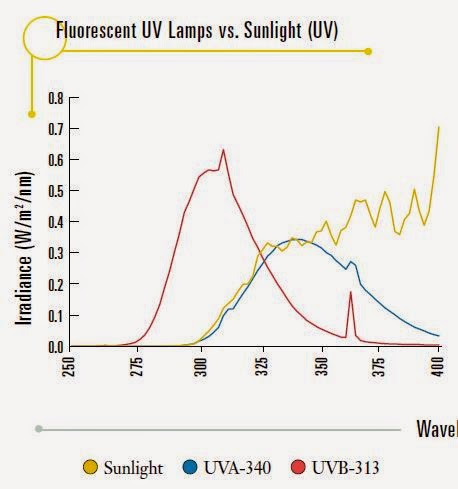
For instance, he has introduced an additional UV testing protocol using UVA bulbs although the germicidal lamps are still being used.
UVA bulbs are better at simulating sunlight than germicidal lamps, but they still are problematic as the graph on the right shows. There is a good match at the lower wavelengths, but the problem is that not all plastics are degraded by shorter wavelengths. A classic paper by Andrady introduced the activation spectra for polymers, a graph which shows that the degradation rate versus the wavelength. Most plastics have a peak in such a plot, with some peaking at higher wavelengths than others. Lacking the activation spectra for a polymer, it is therefore critical to attempt to match the UV spectra of sunlight across the entire UV spectra, not just across a portion that is convenient to test. (Fluorescent bulbs are cheaper to buy and maintain than xenon arc sources, even though the latter can provide a much better spectral match.)

In the past, EA was found by using just the MCF-7 assay, a test that Eastman's experts were quite critical of. This paper also uses a BG1-Luc assay test from UC Davis. Sorry, I don't have enough of a biochem/cell biology background to criticize the test effectively comment on the tests and their validity. But a couple of items did catch my eye. The samples were sometimes extracted with 100% ethanol or various water/ethanol solutions. Why? Also, a variety of blanks were run as controls. But this then lead to selection bias in the results, since when any sham control showed an EA greater than 15% of the response produced by 17β-estradiol (RME-2), the entire experiment was tossed. Why?

The researchers did not run every sample through every stress option and every extraction option, but did a scattering of text configurations. All of which makes it difficult to make broad statements, but nonetheless, I think Figure 3 is telling:
This shows the EA for a variety of samples. 15% RME2 is used as the cutoff for "estrogenic activity". Across the bottom, UN is for unstressed samples, AU is for autoclaved samples, MI is for microwaved samples and UVA and UVC are for the samples exposed to the UVA- and germicidal-lamps respectively. To me, the conclusion is pretty clear. Give so much variation in EA across so many different samples of different colors and processed by some many different manufacturers, it's evident that the base Tritan resin itself does not show EA as seen in Figures 3A and 3B. It's additives, colorants, and processing conditions that lead to a material that can show EA.

For reasons that are not completely clear, the researchers decided to take this matter into their own hands and "roll their own" plastics with additives. They somehow (think) they properly added BHT or BHA to polypropylene. I can't imagine that they did this properly (no details were given - where were the reviewers on this?) and I take issue with the whole approach as well. First, BHT and BHA are seldom used as antioxidants in polymers. Not only are they too volatile, evaporating out of the molten plastic, but they also are rather mobile and will diffuse rather well, leaving the plastic devoid of protection. Instead, BHT derivatives are used. Multiple equivalents of BHT (or BHA) are covalently bonded to a central multifunctional molecule, such a pentaerythritol. The BHT segment is still functional as an antioxidant, but the new molecule is far less volatile and diffusive. So looking at the EA of BHT and BHA (Figures 6A and 6B) is a non-issue for plastics. But secondly, attempting to add and disperse the additives in polypropylene is not something that can be done without the proper equipment. Molten polypropylene is a thick viscous mess and attempting to disperse less than 1 wt% of an additive in a beaker of molten polypropylene with a glass rod is not possible. You need some proper compounding equipment, usually something with intermeshing twin blades in a steel vessel, all of which is heated up.

But then I look at Figure 6C and I want to cry. Some unidentified antioxidants (therefore not something that can be independently verified) were added to polypropylene, and then the polypropylene was kept at 200 oC for 100 hours!!! What was left of the sample if anything beyond a burnt crisp of something that you to be plastic? And somehow the researchers believe that the results are representative of something? How can anyone believe that? 200 oC for 100 hours. Imagine if you had stuck say, a leg of lamb (or a tofu turkey if you are vegetarian) in your oven at home at set it to 200 oC (400 oF) for 100 hours? Besides having multiple visits from the fire department and divorce papers from your spouse ("But Honey! I'm doing this for SCIENCE"), what would be left? Polypropylene is not that different. Why, oh why, oh why does anyone think that this test protocol is of any use at all? And then doesn't that cast an immense question mark across the rest of the test protocols as well?

All in all, this paper, like the previous paper, is just a mess wherein plastic samples have been subjected to extreme questions without merit and then tested for EA. All the previous criticisms I have with this researcher's results still stand. Even when appearing to be responsive and adjusting some test protocols, additional tests, including one which is by far the most abusive test I can imagine have been added. And yet, through it all, there is sufficient data to answer the question I posed in the headline. Is Tritan plastic free of Estrogenic Activity?

Based on the data in this paper, the answer is yes.


Previous Years

March 3, 2011 - On the term "Materials Science"

March 3, 2011 - Who Knew?

Monday, March 2, 2015

Is Tritan Plastic Free of Estrogenic Activity? (Part 1)

[Note: This is the first part of a 3-part series taking a critical look at the work of University of Texas - Austin neuroscience Professor George Bittner regarding estrogenic activity in plastics. Part 1 here gives general criticisms of his work in this area, while Part 2 and Part 3 which looks critically at the results of a pair of 2014 publications.]

It's been a while since I've discussed the work of neuroscientist Prof. George Bittner who claims to have found estrogenic activity (EA) in a wide range of plastic materials, not just polycarbonates that are known to show EA due to the residual bisphenol A (BPA) that resides within them, but polyethylene, polypropylene and more. Pretty much all plastics were implicated, which was quite shocking. This paper came out back in 2011 and he worked up quite a publicity train of hype trumpeting the results in interviews with major news outlets such as the New York Times. Not only was this PR tour driven by his "results", but also by the fact that he owns two companies, Certichem and Plastipure, which are involved in running these types of tests and then supplying plastics that pass the tests, respectively. So you could say there was a potential conflict of interest.

I (and other researchers) had no problem in quickly finding major flaws in the work. His work involved "stressing" the samples, and it was these stressed samples that showed high levels of EA. But there were significant problems with his stressing protocols, namely that he had no controls at all. While Bittner would argue that an unstressed sample would be a control, it isn't. Whenever any is running accelerated "stressing" of plastics (more commonly known as accelerated aging), you need to have control samples that are undergoing natural aging. Without those naturally aged controls, you have no idea if the stressing is in fact aging the samples properly or if it is producing unnatural results.

The classic example are chicken eggs. Heating up a dozen of them in boiling water for 10 minutes is not going to give you a batch of new chicks. That's because excessive heat accelerated undesired chemical reactions, reactions that don't occur in natural aging. Heating and cooling the eggs only within a very-narrow temperature-window will speed-up/slow-down the hatching. Anything else will produce unnatural results.

Or think of it this way, in terms of an imaginary movie script. The bad guys want to know where the good guy keeps some unknown valuable item that they are looking to steal. The natural-aging analogy would be for the bad guys to tail closely the good guy. The accelerated-aging analogy would be for the bad guys to be driving faster ahead of the good guy, occasionally looking in the rear view mirror to see that he's still there. If they correctly predict the good guy's route, they will get to the valuable item first. But if they look back and see that he's turned onto a different route, then the bad guys need to turn around, go back to that turning point and continue. It would be crazy for the bad guys to drive quickly without ever looking back at the naturally-aged control (i.e., the good guy). Such a scene would mean only that they will get somewhere fast, but it may or may not be the right spot at all. Yet that was what Bittner was doing. Going somewhere fast, but with no idea or proof that the final result was correct at all.

And this is not just me saying this. Take a look at these three pictures.
Outdoor Weathering Facility
Miami FL, USA


Phoenix AZ, USA
Magdeburg, Germany
These are all large outdoor weathering facilities and there are dozens of others from around the world that are not shown. If accelerated aging was merely a matter of counting photons, these facilities would not be needed at all.

For Bittner's research, it was even more important than usual to have a proper control as his test methods never identified what specific chemicals were showing the EA. And so it was impossible to know whether it was one or more chemicals that were created during the stress that didn't even exist in the unstressed plastic. Or if the the chemicals would ever develop under natural aging conditions.

Beyond lacking in a naturally aged control, Bittner's stressing protocols were extreme and therefore all the more likely to produce erroneous results. He simulated natural UV aging by exposing the plastic to 254 nm UV light, light that is not naturally occurring on earth, light that is known to be highly energetic and destructive to organic materials. Hence it's use as a germicidal lamp. Photons with a 254 nm wavelength chop up chemicals like a wood chipper chops wood, and all little bits are new chemicals that weren't there before. (Hence my very strong concern for a naturally-aged control.) Similarly, Bittner simulated a dishwasher with an autoclave. (Huh? Don't they have dishwashers in Austin, Texas?) An autoclave produces much higher heat than any dishwasher and it also doesn't "wash" anything. A dishwasher loaded with soap would wash away chemicals that diffuse to the surface which would decrease the chance of producing positive EA results. Similarly, Bittner ran a bunch of plastic samples repeatedly through a microwave. While this appears to be a realistic procedure, very few people run the same container 10 or more times through the microwave without washing it in between uses. And such a washing step would reduce any EA chemicals at the surface. You can now see that these "stress" tests were really just doing a bunch of extreme things to plastic samples that are not correlated to realistic conditions at all. I stated all of this in earlier posts back in 2001. (And it seemed to have had an effect as you will see in Part 2 of this series of posts.)

The accusations made some people upset, including Eastman Chemical. Eastman makes the Tritan family of plastics and has been pushing them heavily as a BPA-free alternative to polycarbonate. Bittner accused Tritan of showing EA, Eastman disagreed and the gloves came off, only being put back on after a jury in Texas agreed that Bittner's claims were invalid. Bittner appealed and lost there too.

Bittner has not given up the fight however. He published two new articles on the same subject matter late last year (which I will criticize wholeheartedly in parts 2 and 3), and is still making interviews, such as a recent one to National Public Radio.
"...Bittner's companies have changed their tactics a bit, says Mike Usey, the CEO of PlastiPure. 'We don't talk about Tritan, or Eastman, in a commercial context concerning the testing results that we have,' he says. 'But that doesn't limit our discussing our research in a scientific context.' That means Bittner and his companies are getting their message out by publishing scientific papers about estrogenic plastics that specifically mention Tritan and products made with it."
While they have changed their tactics on the PR trail a bit and are very careful in their new papers how they mention Tritan, they haven't changed their research tactics. They are still lacking in proper controls, and worse yet, they ignorantly continue to find new ways to abuse plastics without merit or reason, thinking that they are proceeding just fine. Bittner and company may well be fine neuroscientists, but they know next to nothing about polymer chemistry and processing plastics.

A leopard cannot change its spots.


Previous Years

March 2, 2012 - Cancelling a Stink with another Stink?

March 2, 2011 - Nonlinearity in Rheology - Be Afraid, Be Very Afraid

March 2, 2010 - Living without Plastics?

March 2, 2009 - Polymers and their Solubility

March 2, 2009 - Mylar - What it Isn't


Thursday, February 5, 2015

Consuming Plastic

Plastics touch nearly all aspects of our lives, but there is one area that they are noticeably absent from - food. Very little in the way of synthetic polymers are taken in through the mouth. But that will be change for me in a few hours. Later this afternoon I get to consume about 250 g of polyethylene glycol (PEG) with a molecular weight of 3350 Da. Mix into 2 liters of Gatorade, it will taste pretty good, but I really don't recommend this diet for anyone except when advised so by a doctor. (I have been so advised.)

When we first start visiting the doctor for annual physicals, we are told to stick out our tongue and say "Aaaaah". But after 50 years or so, the doctor gets bored with that and decides to start looking at the other end of your GI tract. He/she gets a better view when the road has been cleared, hence the PEG diet. PEG 3350 is an "osmonic laxative".

The rheology of feces can be quantified by the Bristol Stool Scale which runs from 1 to 7:
250 g of PEG 3350 is normally consumed over 14 days, so consuming it in 2 hours is going to, in the words of Spinal Tap, turn it up to 11. And I'll be feeling plenty....wait for it....wait...wait....crappy! (Feel free to add your own puns in the comments below.)


Previous Years

February 5, 2010 - "BPA Free"?

February 5, 2010 - A new concept in hearing aids

February 5, 2009 - Coloured Plastics


Monday, January 5, 2015

Time's "Person of the Year" - and Plastics

Plastics are critical to the fight against Ebola
Over the past couple of holiday weeks, Time Magazine came out with their "Person of the Year" issue. The cover, seen on the right, was all over the newsstands when I was shopping. What hit me the most was that the photo barely showed the person underneath - only their eyes and little bit of skin around the eyes were visible. The rest of the person - covered in plastic.

I've made the point before (1, 2) of how much worse this outbreak would have been without plastics, single-use plastics at that, the favorite whipping boy of anti-plastic environmentalists. I seriously question if many of the people reading this would be alive (including me [*]) and whether the world economy would have collapsed once every nation shut their borders if we didn't have such plastics.

Or perhaps the question is a non-starter, since a world without plastics would lack the ease of travel which leads to the ease of spreading the disease. But in the same vein, I wonder how many lives could have been saved during the Plague had plastics been available. It wouldn't have prevented them all, since germ theory wasn't well understood then, but still, there were enough basic public health practices that plastics could have improved the situation some.

None of this is to take away from the people that still have to don and doff the gear (doffing being the risky part) and they deserve out greatest respect. But there still needs to be some recognition that plastics play a critical role in the fight too. Plastics by themselves won't treat the ill or prevent the spread, the medical professionals need to attend to that, but without plastics, their jobs would go from being hazardous to suicidal.


[*] One of the largest Liberian communities in the US is here in the Twin Cities and many of them have traveled back there during the outbreak, so this city and state were following the outbreak with greater concern than other areas. Further, my father volunteers as an English teacher and many of his students are Liberian immigrants. There's your six degrees of separation.


Previous Years

January 5, 2011 - ANTEC Bound

January 5, 2010 - Amusing Names for Rheology Models

Thursday, October 23, 2014

Who put the "plastic" in plastic surgery?

"Plastic Surgery" is the hot topic of the day (especially as it relates to Renee Zellweger) and so the question arises as to what plastic is used in plastic surgery.

The word "plastic" is an old word that is used in many diverse settings. In materials science, there is plastic deformation. You also have the macromolecules that are the subject of most of the posts on this blog and you have the surgery. It may be surprising, but these uses are all based on the same meaning that the word "plastic" originally meant. "Plastic" comes from the Greek plastikos, meaning moldable.

The use of the word in the area of material science is the oldest application of the word and it refers to an irreversible deformation of a material. All materials can be stretched or bent to some degree so that when the applied force is removed, the material bounces back to its original shape. This is referred to as elastic deformation. But when too much force is applied, the material is permanently deformed - it has undergone plastic deformation. Whether it is a blacksmith pounding out iron, the steel for a car door being stamped or the drunk guy squishing his aluminum beer cans, its all plastic deformation. The material is being molded into a new shape.

With the development of polymers in the 20th century, macromolecules quickly became associated with the term plastic because they are quite moldable. Compared to metals which usually required large amounts of heat and force to mold them, polymers required comparatively little heat and force. The association is so strong that the word "plastic" to most people refers to polymers and little else.

Hence the misunderstanding of the term plastic surgery. The term was originally based on the idea of molding parts of the body through any of a number of techniques, most of which do not involve polymers. But because the word plastic has become equivalent to polymeric materials, you can have Joan Rivers joking about having her dead body donated to Tupperware. In fact, the etymology site noted above states that the term plastic surgery was first used in 1839, well before polymeric materials were described as plastic.

So who put the plastic in plastic surgery? We all did. But keep in mind what the word plastic really refers to: moldability.


Previous Years

October 23, 2013 - Dog and Pony Show

October 23, 2009 - Polymeric Auto Glass

October 23, 2006 - Polymers in the Proceedings